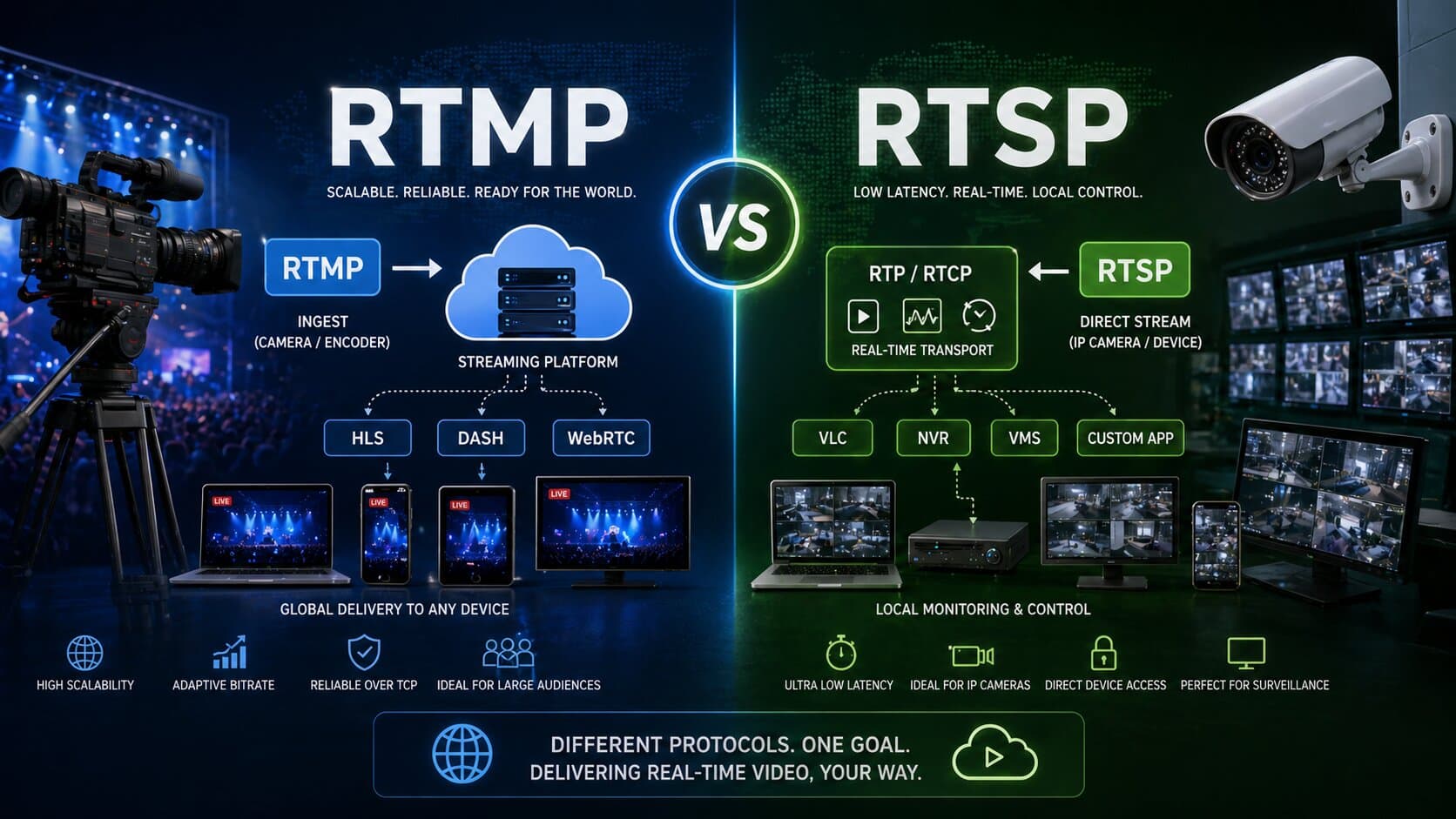
RTSP vs RTMP vs HLS vs WebRTC: streaming protocols compared
Which streaming protocol should you actually use?
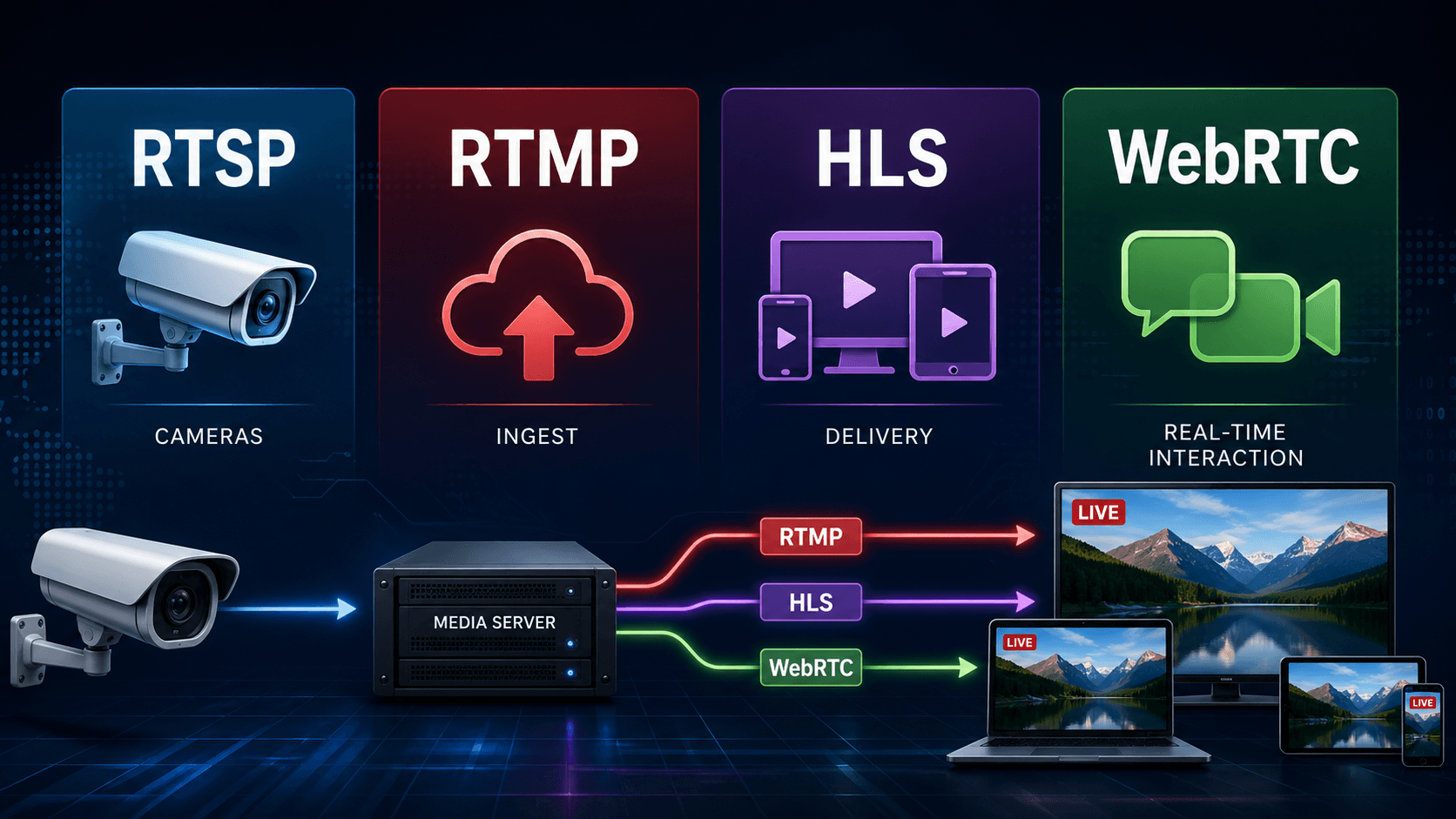
If you’ve ever tried to build a live video pipeline - whether for an IP camera, OBS stream, or a full-scale broadcasting system - you’ve probably run into this exact dilemma. RTSP, RTMP, HLS, and WebRTC are the four most important streaming protocols today. Each one solves a different problem. And here’s the key insight: there is no single “best” protocol. The right choice depends on latency, scale, device compatibility, and how your stream flows from source to viewer.
What are RTSP, RTMP, HLS and WebRTC?
Let’s start with a simple, practical understanding.
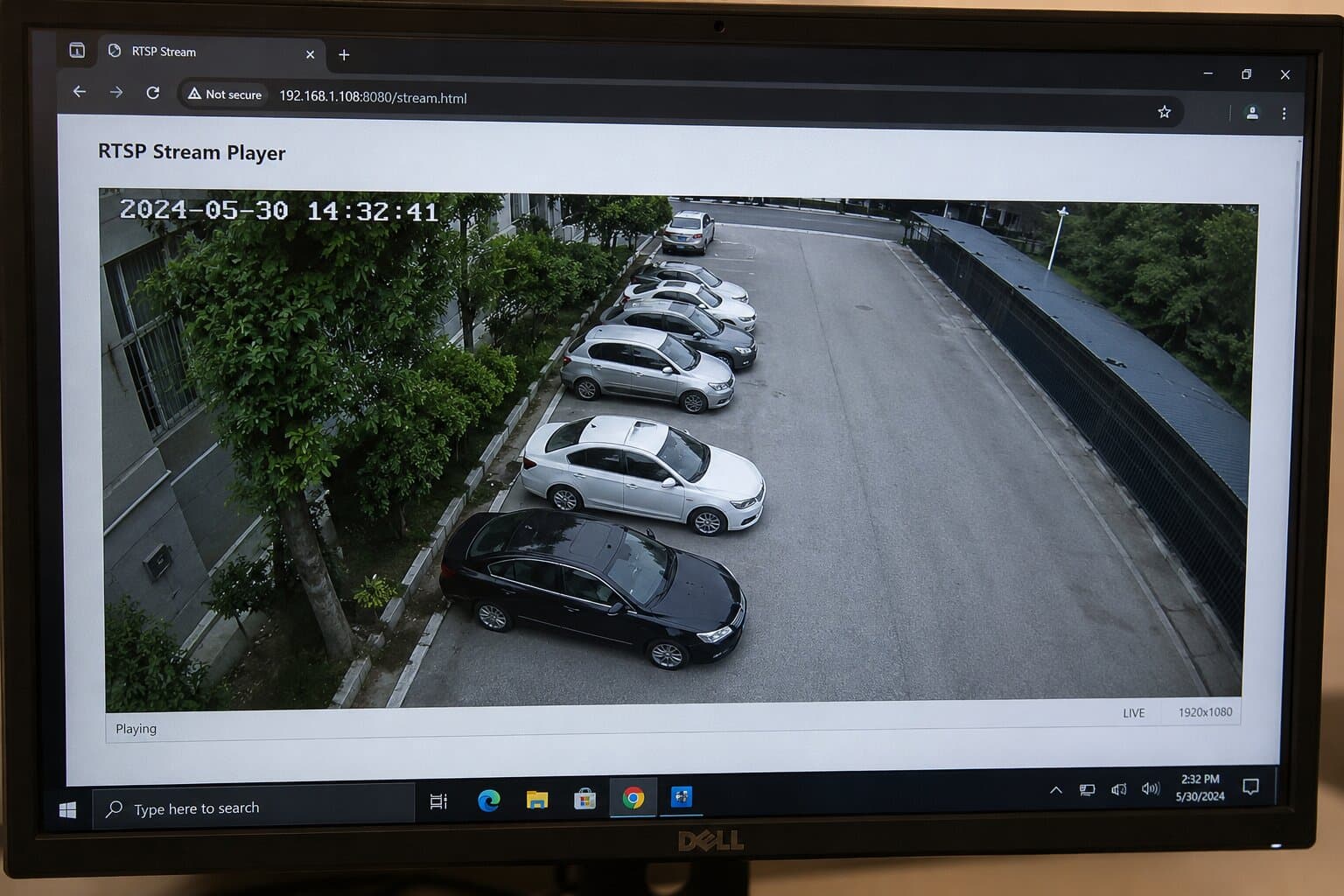
RTSP (Real-Time Streaming Protocol) is used mainly for controlling streams from devices like IP cameras. It’s common in CCTV and surveillance systems, where you “pull” a stream from a device.
RTMP (Real-Time Messaging Protocol) was originally developed by Adobe. Today, it’s still widely used to send (push) live video from encoders like OBS to a streaming server.
HLS (HTTP Live Streaming), created by Apple, is designed for delivering video over the internet. It breaks video into small chunks and delivers them over HTTP, making it highly compatible with browsers and mobile devices.
WebRTC (Web Real-Time Communication) is built for ultra-low latency streaming directly in the browser. It’s what powers video calls, real-time dashboards, and interactive live applications.
Each of these protocols fits into a different stage of the streaming pipeline.
Key differences between streaming protocols
At a glance, the biggest differences come down to latency, transport method, and browser support.
RTSP offers low latency, typically between 0.5 and 3 seconds, and works over TCP or UDP. However, it has no native browser support, which limits its use in web applications.
RTMP provides low latency as well, usually around 2 to 5 seconds, and uses TCP. It is excellent for ingest, but modern browsers no longer support it directly since Flash was deprecated.
HLS focuses on compatibility and scalability. It works over HTTP and is supported almost everywhere, but latency is higher - typically 10 to 30 seconds, although Low-Latency HLS can reduce this to a few seconds.
WebRTC delivers ultra-low latency, often below one second. It uses UDP-based technologies like ICE, STUN, and TURN to establish connections and works natively in modern browsers like Chrome and Firefox.
So if you’re thinking:
- “Which one is fastest?” - WebRTC wins.
- “Which one is most compatible?” - HLS dominates.
- “Which one works with cameras?” - RTSP is your starting point.
- “Which one works with OBS?” - RTMP is still the standard ingest.
When should you use RTSP?
RTSP is the natural choice when dealing with IP cameras, NVR systems, drones, or industrial monitoring.
It is designed for low-latency, real-time access to video streams within a local network or controlled environment. You typically use RTSP when you want to connect directly to a camera and retrieve the stream.
But here’s the catch - RTSP is not web-friendly. If you want to display that camera on a website, you will need to convert it into something like HLS or WebRTC. In practice, RTSP is your input protocol, not your final delivery format.
When should you use RTMP?
RTMP is still incredibly relevant, especially if you work with live streaming tools like OBS.
It is the standard way to send video from an encoder to a streaming server. Platforms like YouTube Live, Facebook Live, and Twitch all rely on RTMP ingest. However, RTMP is not meant for playback anymore. Since browsers dropped Flash support, RTMP is now used behind the scenes. The server receives RTMP, then converts it into HLS or WebRTC for viewers.
Think of RTMP as the “upload protocol” for live streaming.
When should you use HLS?
HLS is the king of scalability.
If your goal is to deliver a stream to a large audience across different devices - desktops, smartphones, tablets - HLS is usually the safest choice.
It works over standard HTTP, which means it plays nicely with CDNs, caching, and firewalls. That makes it incredibly reliable.
The trade-off? Latency. If you are streaming a sports event or a webinar where a 10-20 second delay is acceptable, HLS is perfect. If you need real-time interaction, it may feel too slow.
When should you use WebRTC?
WebRTC is all about immediacy.
If you need real-time interaction - video calls, remote control systems, live monitoring dashboards - this is your protocol. Latency is typically under one second, which completely changes the user experience. It feels instant.
WebRTC works directly in modern browsers, without plugins, and supports peer-to-peer or server-based architectures. The downside? It’s more complex to scale compared to HLS and requires more infrastructure planning.
How modern streaming pipelines actually work
Here’s something many guides don’t explain clearly: in real-world systems, these protocols are often used together.
A typical modern setup looks like this:
Camera → RTSP → Media Server → RTMP/WebRTC/HLS → Viewer
Or for live broadcasting:
OBS → RTMP → Streaming Server → HLS (for viewers)
Or for real-time apps:
Camera → RTSP → Gateway → WebRTC → Browser
This hybrid approach gives you the best of all worlds:
low latency where needed, compatibility where required, and scalability when traffic grows.
Is RTMP better than RTSP?
Not universally. RTMP is usually better for encoder-to-server ingest - for example, sending a live feed from OBS to YouTube, Twitch, or another streaming server. RTSP is usually better for device-originated streams, especially IP cameras, NVRs, and surveillance workflows where a client pulls a feed from the source. In other words, RTMP is stronger in broadcast contribution, while RTSP is stronger in camera and monitoring environments.
So the practical answer is this: if your source is a camera on a local or managed network, RTSP is often the better fit. If your source is a live encoder and your destination is a streaming platform, RTMP is usually the better fit. “Better” depends on where the stream starts and where it needs to go.
Is RTSP still relevant?
Yes, very much so. RTSP is still widely relevant in IP camera, CCTV, surveillance, and other low-latency monitoring setups. It remains a common ingest or control protocol in professional video pipelines even though it is not natively supported in browsers. That lack of browser support does not make RTSP obsolete; it just means RTSP is typically used on the source side, then converted to WebRTC or HLS for web playback.
Today, RTSP is best understood as a backend or first-mile protocol. If you work with cameras, drones, industrial monitoring, or private video networks, it is still highly relevant.
Is RTMP obsolete?
RTMP is obsolete for browser playback, but not obsolete overall. Because Flash is gone, RTMP is no longer a modern viewer-facing playback protocol. However, it is still actively used for live stream ingest by many platforms and media servers. That is why RTMP continues to show up in OBS settings and live production workflows even in 2026.
A precise way to say it is: RTMP is no longer the protocol you use to watch streams in the browser, but it is still one of the most common ways to send a live stream into a platform or server. So it is not dead - its role has simply narrowed.
What is the latency of WebRTC vs HLS?
WebRTC is the low-latency winner. In real deployments, WebRTC is commonly used for sub-second or near-real-time delivery, which is why it powers video calls, remote control, and interactive live apps. HLS, by contrast, is HTTP-segment based and therefore usually has noticeably higher latency. Standard HLS is typically several seconds behind live, while Low-Latency HLS reduces that gap but still usually does not match WebRTC for true real-time interaction.
So if you need a simple rule of thumb: choose WebRTC when delay must feel instant, and choose HLS when compatibility, scale, and CDN-friendly delivery matter more than ultra-low latency.
Which protocol should you choose?
Let’s make this practical.
- If you are working with IP cameras or surveillance → start with RTSP.
- If you are streaming from OBS or an encoder → use RTMP for ingest.
- If you want maximum reach and compatibility → deliver via HLS.
- If you need real-time interaction → choose WebRTC.
- And if you’re building something more advanced? Combine them.
That’s what most professional systems do.