RTMP vs RTSP - Protocol Comparison Guide
When building a modern live streaming setup, choosing the right streaming protocol is crucial.
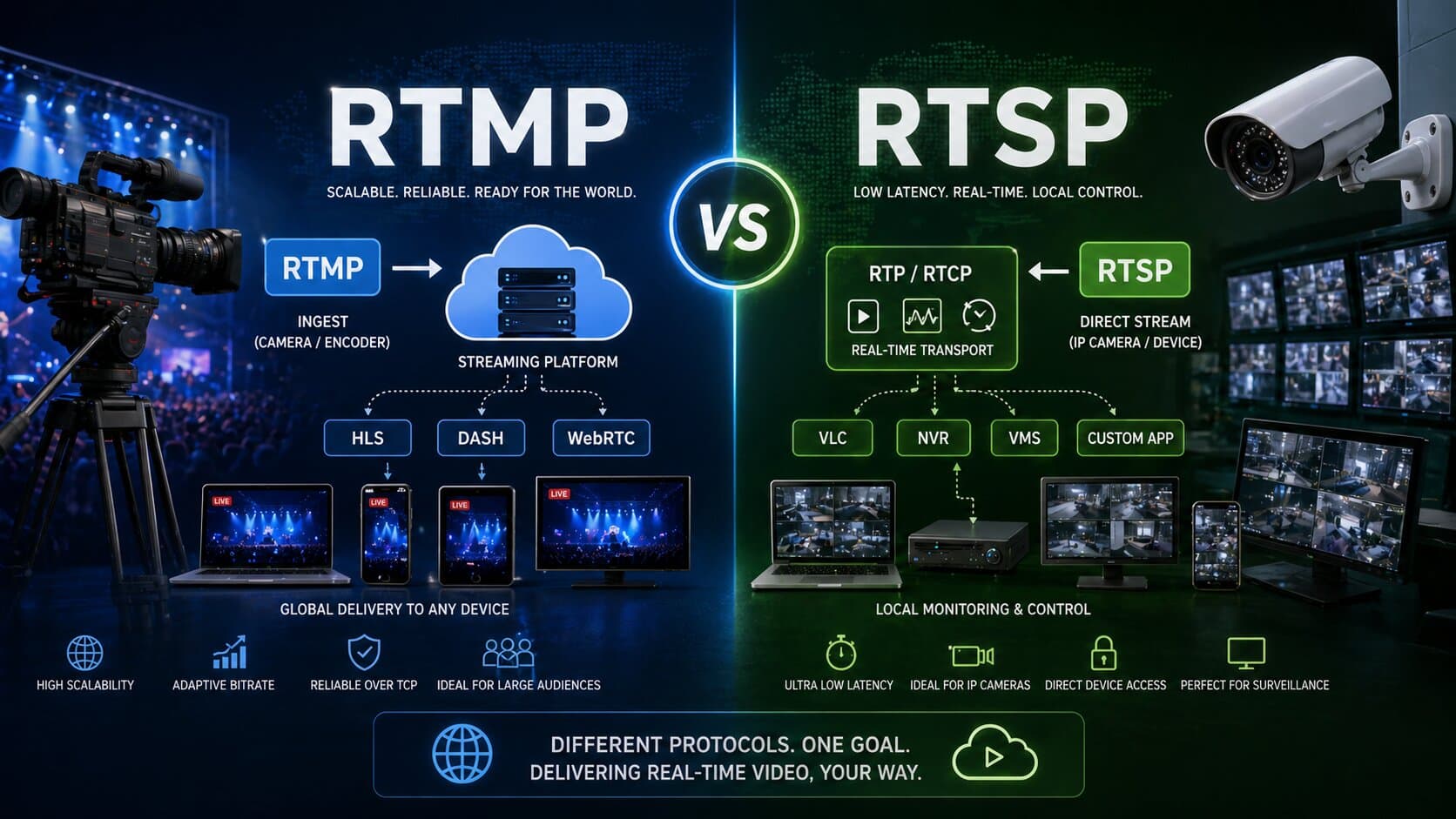
Two of the most commonly used standards are RTMP (Real-Time Messaging Protocol) and RTSP (Real-Time Streaming Protocol). Both enable the delivery of live and on-demand video, but they serve different purposes, have distinct technical architectures, and fit separate use cases.
What is RTMP?
RTMP was originally developed by Macromedia (later acquired by Adobe) to stream audio, video, and data between a Flash player and a server. Even though Flash is no longer used, RTMP remains one of the most stable and widely supported streaming protocols in the world.
RTMP operates over TCP, ensuring reliable data transmission and smooth playback even over unstable networks. It supports adaptive bitrate streaming, automatically adjusting video quality based on available bandwidth to minimize buffering. Because of this, RTMP continues to power live events, webinars, and streaming platforms that prioritize scalability and cross-platform compatibility.
Most modern streaming platforms still use RTMP as the ingest protocol, meaning cameras and encoders send RTMP feeds to the platform, which then re-encodes and distributes the stream using HLS or DASH for web playback. RTMP’s efficiency in data compression during transmission makes it particularly suitable for large-scale internet broadcasting.
What is RTSP?
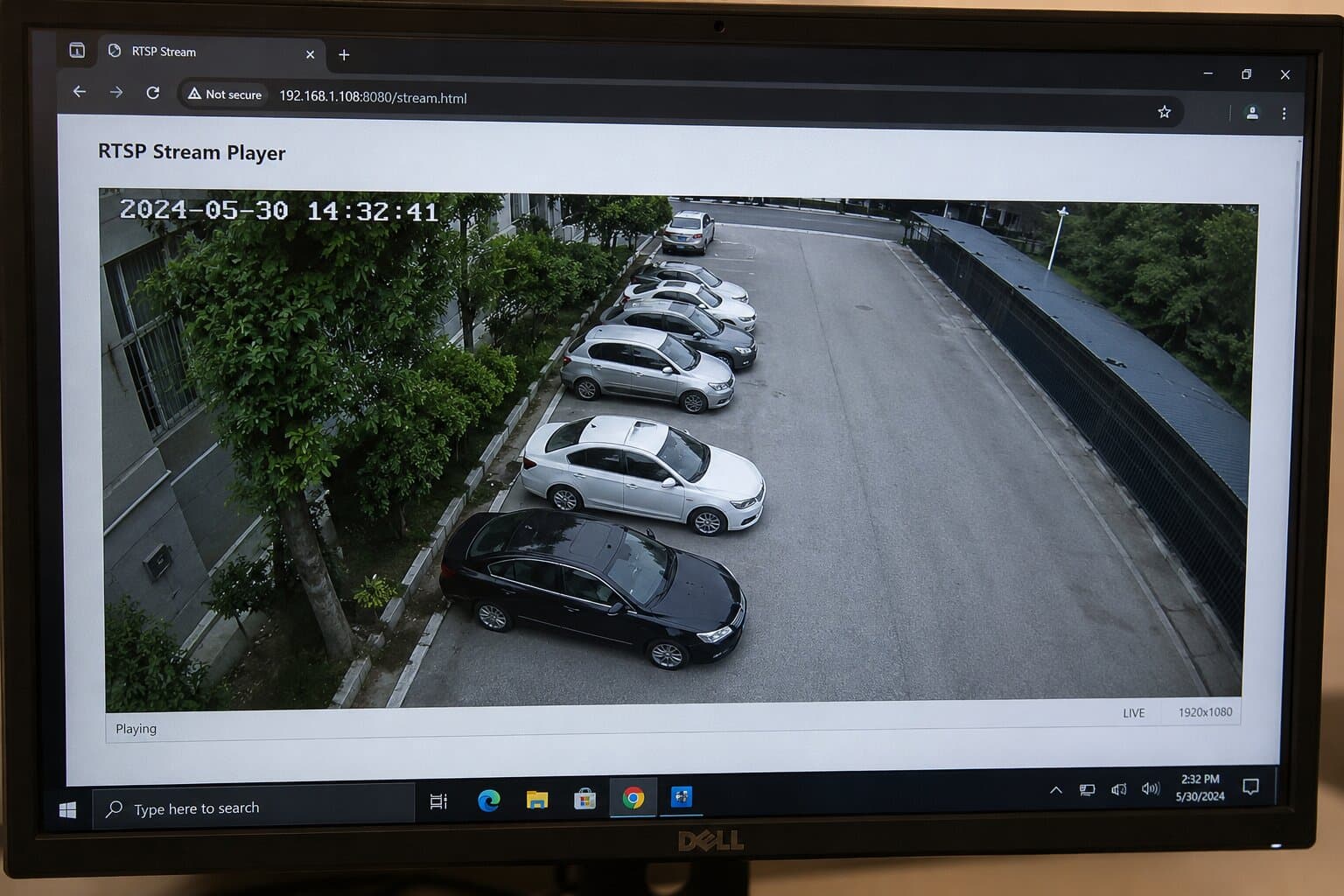
RTSP, in contrast, is a real-time control protocol designed for streaming video directly over IP networks. It is commonly used in surveillance systems, IP cameras, and localized monitoring setups where low latency and real-time feedback are essential.
RTSP typically runs on top of RTP (Real-Time Transport Protocol) for data delivery and RTCP (Real-Time Control Protocol) for synchronization. Unlike RTMP, which works seamlessly in web environments, RTSP usually requires specialized players or applications such as VLC or NVR software, since HTML5 browsers don’t natively support it.
Its strength lies in real-time performance. RTSP can achieve sub-second latency, making it ideal for CCTV monitoring, drone feeds, and other use cases where every millisecond counts. However, it is less efficient in compression and harder to scale for large global audiences.
RTMP vs RTSP - Key Differences
While both protocols transmit live video and audio, their underlying design makes them suitable for different environments.
Feature | RTMP | RTSP |
Primary use case | Internet broadcasting, webinars, social media live streams | Localized streaming, IP cameras, surveillance |
Latency | Moderate (2-5 seconds) | Very low (sub-second possible) |
Transport protocol | TCP | RTP over TCP or UDP |
Browser compatibility | Broad (via HLS/DASH conversion) | Limited (requires dedicated apps) |
Scalability | High - ideal for large audiences | Limited - optimized for small networks |
Compression efficiency | High | Moderate |
Security options | SSL/TLS supported | Depends on device or network setup |
In essence, RTMP is the best option for broad distribution to global audiences, while RTSP is optimized for real-time local monitoring.
When to use RTMP
Choose RTMP if you’re streaming to a large number of viewers online. Its scalability, compression efficiency, and broad compatibility make it the industry standard for live events, corporate webinars, and social media broadcasting. RTMP is also the ingest protocol for most cloud-based streaming platforms, including Realtime, which takes an RTMP input once and distributes it globally through its secure CDN.
When to use RTSP
Use RTSP when low latency and direct device communication are more important than mass scalability. It’s ideal for security monitoring, live production feeds, or private network applications. RTSP is also widely supported by IP cameras and can easily integrate with NVRs and VMS systems for recording and playback.
For businesses managing surveillance or IoT networks, Realtime can ingest RTSP streams from IP cameras and transform them into secure, browser-friendly video accessible to any authorized user anywhere in the world.
RTMP and RTSP in modern streaming workflows
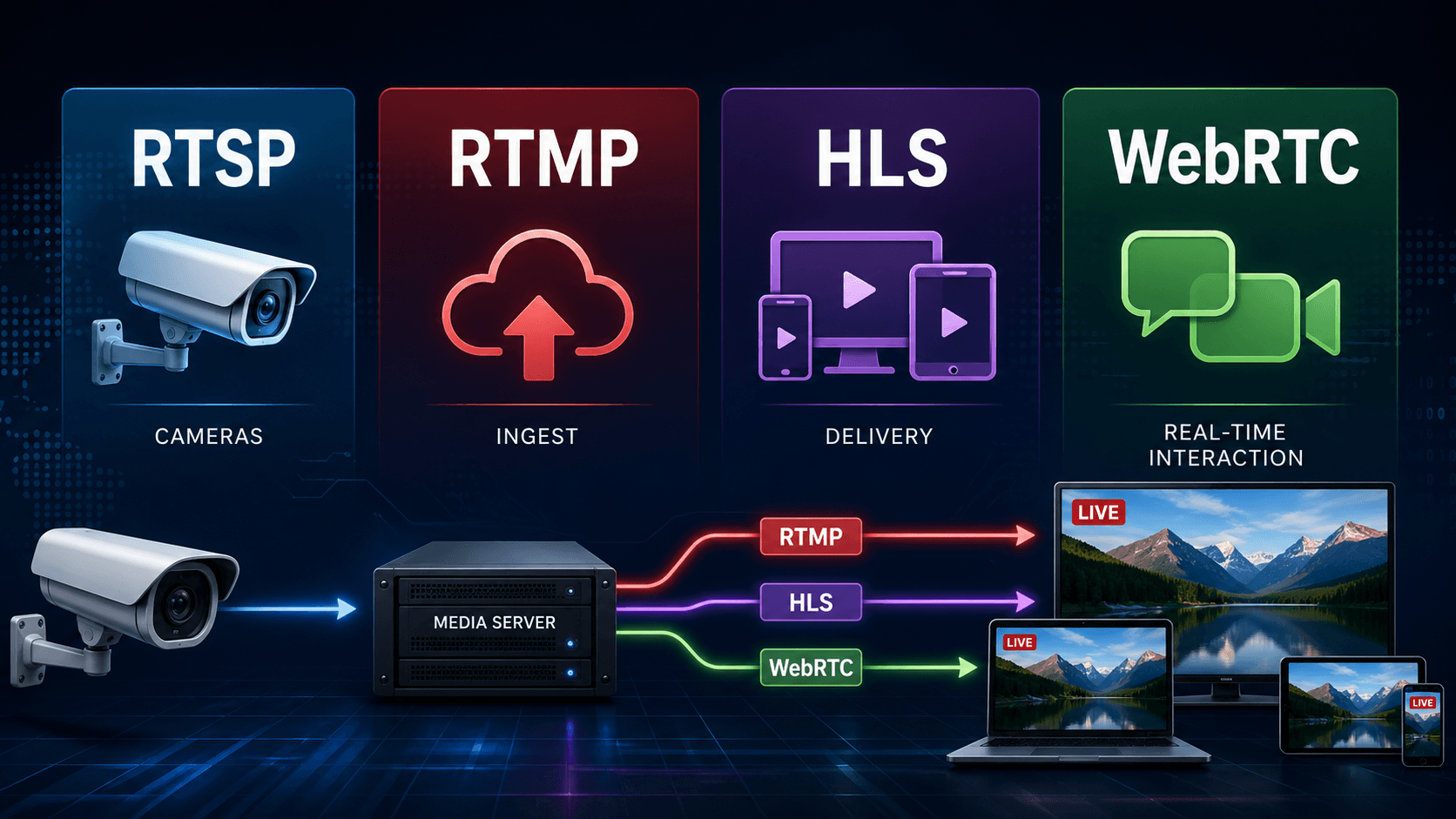
In many professional setups, both protocols coexist. Cameras and encoders often output RTSP for local monitoring and RTMP for cloud delivery. A hybrid workflow might look like this:
- Cameras stream RTSP within the local network for real-time observation.
- The encoder converts the feed to RTMP for stable internet broadcasting.
- A platform like Realtime ingests the RTMP stream and distributes it to global viewers with adaptive playback.
This combination allows creators, event organizers, and enterprises to enjoy the best of both worlds - real-time responsiveness on-site and reliable global scalability online.
Final thoughts
Both RTMP and RTSP are foundational to live video streaming, but their differences are clear. RTMP remains the go-to choice for internet broadcasting where reliability, compression, and cross-device playback matter most. RTSP shines in specialized, low-latency environments like surveillance or internal monitoring.
With Realtime, you can unify both workflows - ingesting RTMP or RTSP streams once, distributing them securely across a global CDN, and managing live and recorded content in one place.