
VBR vs CBR - Video Encoding Comparison
When setting up a streaming workflow, one of the most important decisions is choosing between Variable Bitrate (VBR) and Constant Bitrate (CBR) encoding.
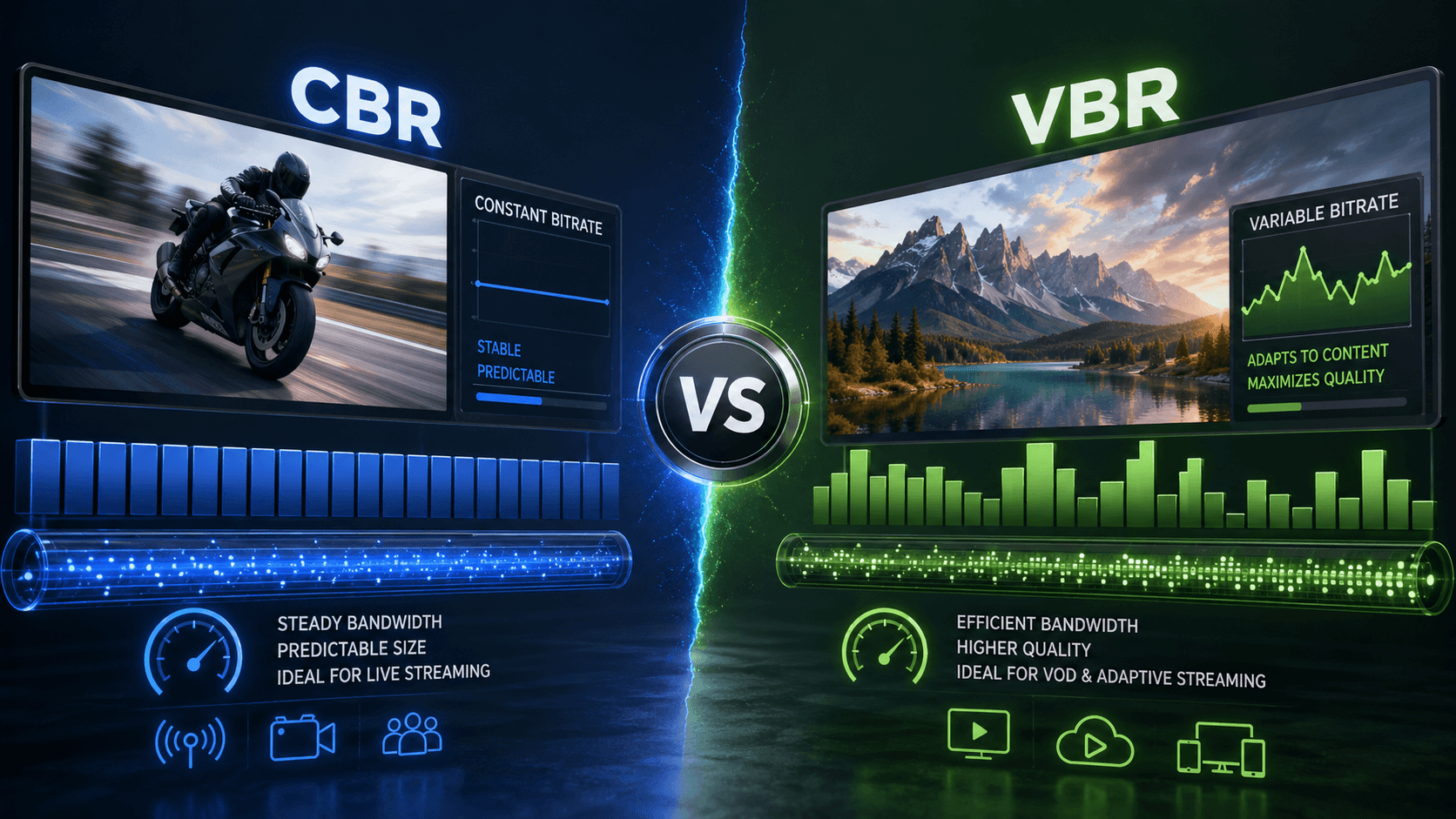
Both methods determine how data is compressed and transmitted, directly affecting video quality, bandwidth usage, and streaming stability.
What is Constant Bitrate (CBR)?
CBR (Constant Bitrate) keeps the data rate fixed throughout the entire video stream, regardless of how complex or simple the content is. This method ensures a predictable file size and stable bandwidth usage, making it ideal for real-time environments where consistency matters.
- Advantages:
- Predictable bandwidth consumption.
- Easier to configure and manage.
- Reliable for live streaming and video conferencing.
- Limitations:
- Wastes bandwidth during simple, low-motion scenes.
- Can introduce compression artifacts in high-motion or complex scenes.
What is Variable Bitrate (VBR)?
VBR (Variable Bitrate) dynamically adjusts the bitrate depending on video complexity. High-motion or detailed scenes receive more data, while static or simple visuals use less. This approach provides better overall quality and more efficient bandwidth usage, but comes at the cost of less predictable file sizes and slightly more complex configuration.
- Advantages:
- Higher quality, especially in detailed or high-motion sequences.
- More efficient use of available bandwidth.
- Widely used in adaptive streaming platforms.
- Limitations:
- Variable file size, making storage harder to predict.
- Slower to encode, often requiring multi-pass processing.
- More complex to configure correctly.
VBR vs CBR - Key Differences
Aspect | CBR | VBR |
Bitrate | Fixed across the entire video | Varies based on scene complexity |
Quality | Consistent but may degrade in complex scenes | Optimized quality for each scene |
File size | Predictable and stable | Variable, depends on content |
Bandwidth usage | Less efficient, may waste data | Efficient, adjusts to content |
Use case | Live streaming, video calls, stable bandwidth | Video on demand, adaptive streaming |
Encoding passes | Single pass, faster | Often two passes, slower but precise |
Setup complexity | Simple and straightforward | More advanced setup required |
When to use CBR?
CBR is the preferred option when stability and predictability are more important than maximum quality. Best for:
- Live streaming church services, webinars, and conferences.
- Video conferencing where low latency is critical.
- Environments with fixed or limited bandwidth capacity.
With CBR, you can avoid sudden bitrate spikes that may cause buffering for viewers with slower connections.
When to use VBR?
VBR is best suited for scenarios where quality and efficiency are the priority, and encoding can take more time. Best for:
- Video on demand (VOD) platforms.
- Adaptive bitrate streaming where viewers have different internet speeds.
- Content libraries where storage efficiency and quality balance matter.
By allocating more data only when necessary, VBR ensures that viewers experience higher visual fidelity without wasting bandwidth.
Final recommendations
The choice between VBR vs CBR depends on your streaming scenario:
- If you need real-time consistency with stable bandwidth (live events, conferencing), go with CBR.
- If you want maximum quality and efficiency for pre-recorded or adaptive content (VOD, OTT platforms), choose VBR.
For large-scale live streaming, platforms like Realtime can ingest either encoding method and distribute streams globally via a secure CDN. This ensures smooth delivery regardless of whether you choose the predictability of CBR or the quality optimization of VBR.